The Complete Cat Nutrition Guide: How to Feed Your Cat Properly
Walk into any pet store and the cat food aisle will hit you with about four hundred different bags, cans, pouches, and freeze-dried mystery products — all claiming to be the best, healthiest, most veterinarian-recommended option in cat food history. It’s overwhelming. I know. I’ve stood there too.
Here’s the thing: cats actually have pretty specific nutritional needs, and they’re not the same as dogs or humans. Cats are obligate carnivores. Their bodies are built to run on animal protein. They need certain amino acids — like taurine — that they can’t make on their own. Get the fundamentals right, and most of the rest of the cat feeding world falls into place.
This nutrition guide is meant to take the confusion out of feeding your cat. We’ll cover the basics of feline nutrition, the different food types and what they actually do, how to decode food labels without a chemistry degree, how to feed cats at different life stages, and the everyday practices that turn mealtime into something simple rather than stressful.
Quick honesty disclaimer up front: I’m not a veterinary nutritionist, and nothing in this guide is meant as medical or prescription dietary advice. If your cat has special dietary needs because of a health condition, please loop in your vet before changing their food. For everything else — the foundational stuff every cat parent should understand about feline nutrition — you’re in the right place.
Let’s get into it.

Why Cat Nutrition Matters
Nutrition is one of the highest-leverage choices in cat ownership. What you feed your cat shapes their energy, coat condition, weight, digestion, hydration, and overall quality of life — not just today, but over years. Cats fed appropriately tend to thrive. Cats fed inappropriately tend to have ongoing problems that humans often blame on other things.
Cats are also fascinatingly unforgiving when it comes to diet. Unlike dogs, who can adapt to a wide range of foods, cats have rigid biological requirements. They need certain nutrients in specific forms, in specific ratios. Skip taurine for too long and a cat develops serious deficiencies. Feed too few calories from animal protein and a cat starts breaking down their own muscle. Their metabolism doesn’t pivot the way ours can.
The good news is that most commercial cat foods that meet established nutritional standards cover the basics. The bad news is that “most” isn’t “all” — and the differences between brands, formulations, and food types actually do matter. Knowing what to look for transforms cat feeding from guesswork into something straightforward.
Cat nutrition isn’t about finding the one perfect food. It’s about understanding what cats need, choosing food that delivers it, and matching the feeding approach to your cat’s life stage, lifestyle, and preferences.
Cat Nutrition Basics: What Cats Actually Need
Before any specific food decisions make sense, it helps to understand what cats biologically require. The science here is well established, even if the marketing around it gets noisy.
Cats Are Obligate Carnivores
“Obligate carnivore” isn’t a buzzword. It’s a real biological category that means cats must consume animal-based nutrients to survive and thrive. Unlike dogs, who are technically omnivores and can adapt to varied diets, cats have evolved to get most of their nutrition from prey.
A few practical implications:
Cats need significantly more dietary protein than dogs or humans. Most experts recommend high-protein diets with most of that protein coming from animal sources. Plant proteins, while present in many cat foods, aren’t a complete substitute for animal protein for cats.
Cats can’t efficiently convert plant-based nutrients into the forms they need. Beta-carotene from plants doesn’t convert into vitamin A in cats the way it does in humans. Plant-based omega fatty acids aren’t fully usable. This is why purely plant-based diets are generally inappropriate for cats — their bodies simply aren’t built to extract complete nutrition from plant sources.
Cats need taurine — an amino acid found in animal tissue but largely absent from plants. Taurine deficiency causes serious problems over time. Quality commercial cat foods include supplemented taurine to ensure adequate levels.
The takeaway: cats need meat. Real animal-based protein should be the foundation of any cat’s diet. Anyone telling you cats can thrive on a vegetarian or vegan diet isn’t grounded in feline biology.
Key Nutrients Cats Need
Beyond protein, cats need a specific combination of nutrients in the right ratios:
Protein — the primary energy source for cats, sourced from animal tissue Fat — provides energy and supports skin and coat health Taurine — an essential amino acid cats can’t manufacture themselves Arachidonic acid — a fatty acid cats can’t synthesize from plant sources Vitamin A — cats need preformed vitamin A from animal sources, not plant precursors Niacin and other B vitamins — needed in higher amounts than for many other species Water — often underconsumed by cats, which is why food moisture content matters
Cats also need minerals like calcium and phosphorus in appropriate ratios, plus other vitamins and trace nutrients. The reason quality commercial cat foods exist is that formulating a complete cat diet from scratch is genuinely complex.
What Cats Don’t Need
A few things that get marketed heavily but aren’t actually nutritional necessities for cats:
Grains as villains. Most cats don’t have grain allergies. The “grain-free” movement has more marketing momentum than scientific support for the average cat. Some cats genuinely benefit from grain-free formulas due to specific sensitivities, but for most cats, grain inclusion isn’t inherently a problem.
Excessive carbohydrates. Cats don’t need significant amounts of carbohydrates. They can use them, but their bodies are built to run on protein and fat. Foods that are mostly carbohydrate (some lower-quality dry foods) don’t match cat biology well.
Boutique ingredients. Quinoa, kale, blueberries, sweet potato — these show up in pet food marketing but offer modest nutritional value for cats compared to quality animal protein.
Human-grade luxury framing. “Human-grade” sometimes means quality ingredients and sometimes means clever marketing. Look at the actual nutritional profile rather than the marketing language.
The point isn’t that these things are harmful. The point is that they’re often emphasized over what actually matters: protein quality, complete nutrition, and life-stage appropriateness.
How to Read Cat Food Labels
Cat food labels are designed to look reassuring more than to communicate clearly. Once you know what to look for, the actual useful information becomes obvious — and the marketing fluff becomes easier to ignore.
The AAFCO Statement
The single most important thing on any cat food label is the AAFCO statement. AAFCO is the Association of American Feed Control Officials, which sets the nutritional standards for pet food sold in the United States.
Look for a statement that says something like:
“This food is formulated to meet the nutritional levels established by the AAFCO Cat Food Nutrient Profiles for [life stage].”
Or:
“Animal feeding tests using AAFCO procedures substantiate that [product name] provides complete and balanced nutrition for [life stage].”
The life stage matters. AAFCO recognizes:
- Growth (for kittens)
- Maintenance (for adult cats)
- All Life Stages (suitable for both kittens and adults — usually formulated to growth standards)
- Gestation/Lactation (for pregnant and nursing cats)
If a cat food doesn’t have an AAFCO statement, that’s a meaningful gap. It means the food hasn’t been formulated to meet established nutritional standards. Skip it.
The “Feeding Tests Substantiate” version is generally considered stronger evidence than “Formulated to Meet,” because it means the food was actually tested in cats, not just calculated on paper. Both are acceptable, though.
The Ingredients List
Ingredients are listed by weight before processing, which can be a little misleading. Fresh meat is mostly water, so it weighs more before processing than an equivalent amount of meat meal — even though meat meal often contributes more actual protein.
What to look for in a quality cat food:
- A named animal protein in the first few ingredients (chicken, turkey, salmon, beef, etc.)
- Recognizable ingredients overall
- Limited fillers
- Specific protein sources rather than vague “meat” or “animal by-products”
What’s not necessarily a red flag:
- Grains, in reasonable amounts
- Animal by-products that are specifically named (chicken by-products often include nutrient-dense organ meat)
- Vegetables in modest amounts
What is generally a red flag:
- Unnamed protein sources (“meat meal” with no specific animal)
- Ingredient lists dominated by grains or fillers
- Artificial colors and excessive preservatives (BHA, BHT, ethoxyquin are commonly avoided)
The Guaranteed Analysis
The guaranteed analysis section tells you the minimum or maximum percentages of certain nutrients:
- Crude Protein (minimum) — should be substantial for cats
- Crude Fat (minimum) — important energy source
- Crude Fiber (maximum) — cats don’t need a lot
- Moisture (maximum) — dramatically different between wet and dry foods
Comparing wet and dry foods using these numbers directly is misleading because of the moisture differences. Wet food might show 10% protein, dry food might show 35% protein — but on a dry-matter basis (removing the water), the actual protein percentages are often comparable.
If you want to compare foods accurately, you can calculate dry-matter basis nutrients, but for everyday cat feeding decisions, the main thing is choosing foods with substantial protein from quality sources, appropriate fat, and reasonable moisture for the food type.
Marketing Terms That Don’t Mean What People Think
A few terms that show up on labels but don’t have strict regulatory definitions:
“Natural” — vague and largely unregulated “Premium” or “Gourmet” — marketing terms with no nutritional meaning “Holistic” — has no regulatory definition for pet food “Human-grade” — has a strict definition only in some contexts; often used loosely “Veterinarian recommended” — meaningful only if you know which vets and why
These aren’t necessarily warning signs, but they shouldn’t be the basis for choosing a food. The AAFCO statement and ingredients list tell you more.
Different Types of Cat Food
The wet vs. dry debate has been going on forever, and the honest answer is: most cats do well on either, and many cats do well on a combination. Different food types have different strengths.
Wet Cat Food
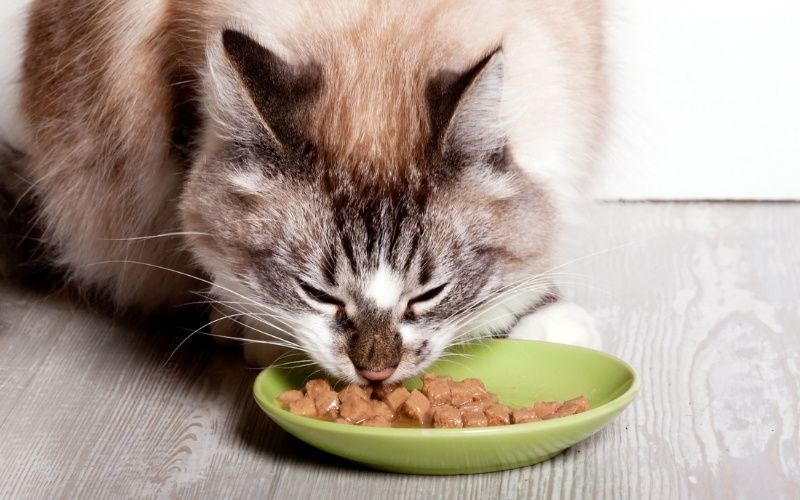
Wet food (canned, pouches, fresh refrigerated) contains roughly 70-80% moisture, which closely matches the moisture content of a cat’s natural prey diet.
Strengths of wet food:
- High moisture content supports hydration
- Often higher in protein on a dry-matter basis
- More palatable for many cats, especially picky eaters
- Easier for older cats with dental issues to eat
- Generally lower in carbohydrates
Drawbacks:
- More expensive per calorie than dry food
- Spoils quickly once opened
- Requires refrigeration after opening
- Can be messier
- Some cats find it less satisfying for grazing throughout the day
Wet food is often considered the closer match to a cat’s biological design, particularly because of the moisture content. Many veterinarians recommend at least some wet food in a cat’s daily diet, especially for cats who don’t drink much water.

Dry Cat Food
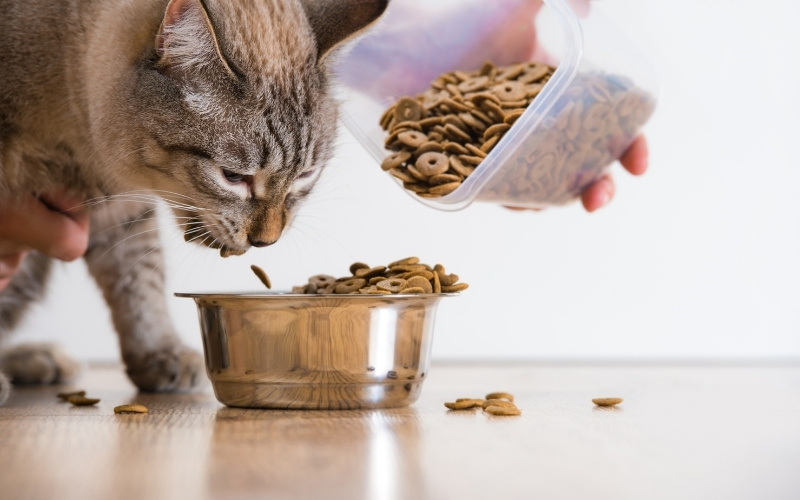
Dry food (kibble) contains roughly 6-10% moisture and is the most commonly fed type of cat food in American households.
Strengths of dry food:
- Convenient and shelf-stable
- More economical per calorie
- Can be left out for grazing
- Easier to portion accurately
- Some forms support dental wear through chewing
Drawbacks:
- Much lower moisture content
- Often higher in carbohydrates
- Some cats overconsume it when free-fed
- Dental benefits are sometimes overstated by marketing
Dry food alone isn’t inherently bad, but for cats who don’t drink much water, relying entirely on dry food can mean lower overall hydration. Many cat parents include at least some wet food specifically to support water intake.
Fresh and Freeze-Dried Cat Food
Newer categories of cat food that have grown significantly in recent years.
Fresh cat food is delivered refrigerated or frozen and typically uses higher-quality ingredients with less processing. Brands like Smalls, Nom Nom, and Cat Person operate in this space. The food is often closer to homemade in style.
Strengths:
- Higher quality ingredients
- Less processing
- Many cats find it highly palatable
- Often portion-controlled
Drawbacks:
- Significantly more expensive
- Requires refrigeration and planning
- Subscription-based for most brands
Freeze-dried cat food removes moisture while preserving more of the natural structure of the food. Often used as toppers or treats, sometimes as complete diets.
Strengths:
- Long shelf life without refrigeration
- High protein concentration
- Many cats find it irresistible
- Often very clean ingredient lists
Drawbacks:
- Expensive
- Requires rehydration in many cases for adequate moisture
- Quality varies significantly between brands
Both categories tend to work well for cats who tolerate them. They’re not necessary for good cat nutrition, but they can be excellent options for cat parents who want to feed something closer to whole-food.

Raw Diets
Raw feeding has passionate advocates and equally passionate critics. The basic idea is feeding cats raw meat, organs, and bones in some form — either prepared at home or commercially formulated.
The potential benefits often cited:
- Closer to a cat’s natural diet
- Higher protein, lower carbohydrate
- Many cats thrive on it
The real concerns:
- Bacterial contamination risk for both cats and humans handling the food
- Nutritional imbalance if not formulated carefully
- Complexity of safe preparation
- Cost (commercial raw is expensive)
This is genuinely a topic where vet involvement matters. Raw feeding done well requires real knowledge. Raw feeding done casually can create problems. If you’re considering raw, have a thorough conversation with your vet first.
Homemade Cat Food
Homemade cat food sounds appealing — fresh ingredients, full control, no mystery additives. The execution is harder than most people realize.
Formulating a complete cat diet from scratch is complex. Cats need specific nutrients in specific ratios, and getting it right requires knowledge of feline nutrition that most home cooks don’t have. Improperly formulated homemade diets are one of the most common causes of nutritional deficiency in pet cats.
If you’re interested in homemade feeding, working with a veterinary nutritionist to develop appropriate recipes is the responsible path. Random internet recipes — even well-meaning ones — often miss key nutritional requirements.
Cat Nutritional Needs by Life Stage
What cats need to eat changes significantly across their lives. The same food isn’t right for every stage.
Kitten Nutrition (0-12 Months)
Kittens grow fast and burn through calories. They need food formulated for growth, which has different protein, fat, and calorie densities than adult food.
Key principles for kitten feeding:
- Use kitten-specific food until around 12 months for most breeds
- Larger breeds like Maine Coons may benefit from kitten food longer (sometimes 18-24 months)
- Look for “AAFCO formulated for growth” or “for all life stages”
- Feed more frequently than adult cats (3-4 meals daily for young kittens)
- Free-feeding is more acceptable for kittens than for adults
- Never feed kittens cow’s milk
The transition from kitten food to adult food should happen gradually over a week or two, around the 12-month mark for most breeds.
Adult Cat Nutrition (1-7 Years)
Adult cats have lower calorie needs than kittens but still require high-quality protein-rich diets. The main shift in adult feeding is maintaining weight and supporting general health rather than fueling rapid growth.
Key principles:
- Adult maintenance formulas are appropriate for most adult cats
- Most adult cats do well on 2-3 meals per day
- Portion control becomes more important as growth slows
- Activity level and lifestyle influence calorie needs
- Hydration matters — wet food in some form supports daily water intake
Adult cats often develop strong food preferences. Switching foods abruptly can cause digestive upset and protest. Gradual transitions work better.
Senior Cat Nutrition (11+ Years)
Cats are typically considered senior around age 11, though many stay active and healthy well into their teens. Senior cat nutrition is less about a single dietary change and more about paying close attention to individual needs.
Things that may shift in senior cats:
- Caloric needs may decrease as activity reduces (but not always)
- Some senior cats lose muscle mass and benefit from higher-quality protein
- Dental issues may make wet food easier to eat
- Hydration becomes even more important
- Some cats benefit from senior-formulated foods, but not all do
This is genuinely an area where vet input matters. Your vet can assess your individual senior cat’s body condition, dental health, and overall status to recommend appropriate dietary adjustments. Generic “senior food” isn’t automatically right for every senior cat.
Life Stage Transitions
Switching foods at any life stage transition should happen gradually:
- Days 1-2: 75% old food, 25% new food
- Days 3-4: 50% old food, 50% new food
- Days 5-6: 25% old food, 75% new food
- Day 7+: 100% new food
Some cats handle faster transitions, some need slower ones. Watch for digestive upset and adjust pace accordingly.
How Much to Feed a Cat
Portion sizes depend on too many variables to give one definitive answer, but here are the principles that matter.
Starting With the Bag
Cat food packaging includes feeding guidelines based on weight. These are starting points, not prescriptions. Most guidelines assume average activity levels and lifestyles, which may not match your individual cat.
A typical adult cat needs roughly 200-300 calories per day, depending on weight, activity, and metabolism. Some cats need less, some need more. The label tells you how many calories per cup or per can.
Adjusting Based on Body Condition
The right portion size is one that maintains your cat at a healthy body condition. Visual and tactile checks matter more than numbers:
A cat at healthy weight has:
- A visible waist when viewed from above
- Ribs that can be felt without firm pressure but aren’t sharply visible
- A modest abdominal tuck
- Appropriate weight for their breed and frame
If your cat is overweight or underweight, the portion size needs adjustment — but this is a conversation worth having with your vet rather than guessing. Your vet can recommend a target weight and caloric range for your individual cat.

Free-Feeding vs. Scheduled Feeding
There are two main feeding philosophies, and both can work depending on the cat.
Free-feeding means leaving food available all day, letting the cat eat when they want. Works well for cats who self-regulate. Problematic for cats who overeat. Generally not recommended for wet food (spoils too quickly) but commonly used with dry food.
Scheduled feeding means measured meals at consistent times. Better portion control, builds routine, easier in multi-cat homes, and supports better health outcomes for cats who tend to overeat. Most adult cats do well on 2-3 scheduled meals per day.
Many cat parents do a hybrid approach: scheduled wet food meals plus a measured amount of dry food available between meals.
Multi-Cat Feeding
Households with multiple cats often face the challenge of one cat eating the other cat’s food, or one cat being a slower eater who loses out to a faster one.
Strategies that help:
- Separate feeding stations in different locations
- Different rooms during mealtime if needed
- Microchip-activated feeders that only open for the registered cat
- Slow feeders for fast eaters
- Elevated feeding spots for cats who shouldn’t share food (e.g., one cat on a specific diet)
Multi-cat feeding isn’t about being fair. It’s about each cat getting the nutrition appropriate for them.
Treats, Table Scraps, and Foods to Avoid
Treats and table scraps are part of cat parenting reality. Done thoughtfully, they’re fine. Done casually, they can throw off nutrition or create problems.
How to Think About Treats
A common guideline is keeping treats to roughly 10% of daily calories. Treats are mostly extra calories without complete nutrition — too many shift the overall diet balance.
Good treat practices:
- Use treats for training and bonding moments
- Choose high-protein, simple treats over heavily processed ones
- Read treat labels — many “cat treats” are mostly fillers and sugars
- Account for treat calories in the overall daily total
- Single-ingredient treats (freeze-dried chicken, salmon) tend to be cleaner options
Human Foods to Avoid
Several human foods are toxic or problematic for cats:
- Chocolate — toxic
- Onions, garlic, chives, leeks — toxic
- Grapes and raisins — toxic
- Alcohol — toxic even in small amounts
- Caffeine — toxic
- Xylitol (artificial sweetener) — highly toxic
- Raw dough — dangerous
- Cow’s milk — most cats are lactose intolerant
- Bones from cooked meat — splinter risk
- Excessive fat or fatty cuts — can cause digestive issues
When in doubt, don’t share human food with your cat. The risk usually isn’t worth the moment of indulgence.
Foods That Are Generally Okay
Some human foods are safe in small amounts for most cats:
- Cooked plain chicken, turkey, beef (no seasoning)
- Cooked plain fish (occasional, not as a staple)
- Small amounts of cooked egg
- Plain pumpkin (sometimes helpful for digestion)
Even safe foods should be occasional, unseasoned, and never substitute for proper cat food. Human food isn’t formulated for cats — it’s an occasional supplement at most.
Water and Hydration
Water is technically a nutrient, and it’s one cats often don’t get enough of. Hydration affects almost every aspect of cat health, which is why it deserves dedicated attention.
Why Cats Often Underdrink
Cats evolved from desert ancestors who got most of their water from prey. Their thirst drive isn’t as strong as other species, which means they often don’t drink as much as they ideally would, especially on dry-food-only diets.
Signs your cat may not be drinking enough:
- Concentrated, dark urine
- Less frequent litter box use
- Drier coat
- Less interest in drinking from their bowl
Encouraging Better Hydration
Practical changes that help:
- Multiple water sources throughout the home
- Wide, shallow bowls rather than narrow deep ones (whisker fatigue is real)
- Ceramic or stainless steel bowls rather than plastic (some cats dislike plastic taste)
- Water fountains — many cats drink significantly more from running water
- Wet food in the diet — adds significant moisture intake
- Fresh water daily, with bowls washed regularly
- Water away from food — cats often prefer separated sources
If you notice a significant change in water intake — much more or much less than usual — that’s worth mentioning to your vet.
Building Good Feeding Practices
The principles above turn into a daily practice when you commit to a few consistent habits.
Feed at Consistent Times
Cats thrive on predictability. Consistent feeding times help with appetite regulation, behavior, and overall routine. Most cats know exactly when meals should arrive and will tell you about it.
Measure Portions
Eyeballing portions sounds harmless but often leads to gradual overfeeding. A measuring cup or a small kitchen scale takes seconds and keeps everything accurate.
Watch the Cat, Not Just the Bowl
Your cat’s body condition tells you more about whether you’re feeding right than the bag’s recommendation does. Adjust based on weight trends over weeks, not single meals.
Transition Foods Gradually
Sudden food changes cause digestive upset and stress. A week-long transition handles most switches comfortably.
Keep Bowls Clean
Food and water bowls should be washed regularly. Bacteria builds up faster than you’d think, especially in wet food bowls. A quick daily rinse and weekly thorough wash keeps things hygienic.
Notice Changes
Sudden appetite changes — eating much more or much less than usual — are worth paying attention to. A single off day is usually nothing. A pattern is worth a vet conversation.
The Cat Nutrition Mindset
If everything in this guide compressed into a few principles, it would be these:
Cats need meat. Animal protein is the foundation of feline nutrition. This isn’t negotiable.
Look for the AAFCO statement on any cat food. That’s your quality baseline.
Wet food helps hydration. Most cats benefit from at least some in their diet.
Free-feeding works for some cats; scheduled feeding works for others. Both are valid, but scheduled feeding tends to be better for portion control.
Don’t switch foods cold turkey. A week of gradual transition prevents most problems.
Treats are around 10% of daily calories. Less is better than more.
The body condition test matters more than the label’s feeding guide. Watch your cat, not just the bowl.
Always loop in your vet for diet changes related to health issues. Generic dietary advice from the internet isn’t a substitute for veterinary input on your specific cat.
Cat nutrition isn’t about finding the one perfect food. It’s about understanding the fundamentals, choosing food that meets them, and feeding consistently with attention to your cat’s individual needs. The cat you live with five years from now is shaped, in real ways, by what you feed them today. Pay attention to the basics. Adjust when you need to. Ask your vet when you’re not sure.